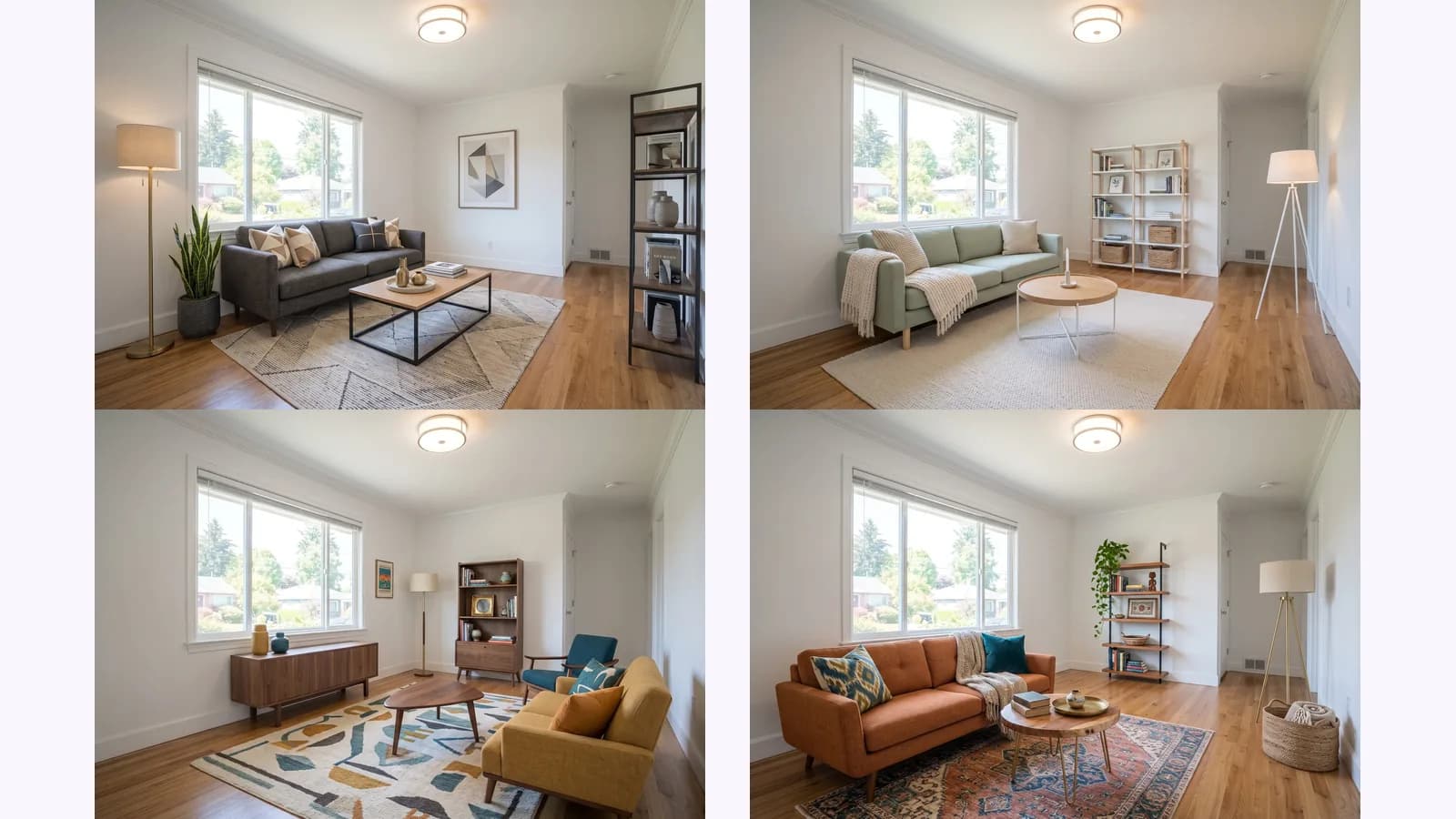
Virtual staging an empty room: 4 styles, same camera
How to virtually stage an empty room: shoot one level corner photo, stage it, then check every change against the original. One room shown in 4 styles.
Do you have to disclose virtual staging? What California AB 723, CRMLS, Stellar MLS, NAR and Wisconsin say, quoted and dated. General info, not legal advice.
Virtual staging disclosure comes down to two habits: label every virtually staged photo as staged where buyers see it, and keep the unaltered original. In California, a law in force since January 1, 2026 also requires a link to that original. Wisconsin adds its own disclosure rule on January 1, 2027. This is general information, not legal advice.
This post is for listing agents, photographers and stagers who use virtual staging. It quotes each rule from its own source and gives the date we checked it. It does not cover every MLS, so check with your MLS and broker before you publish.
Key takeaways
Assume yes. Nothing in the rules quoted below bans virtual staging; they govern labelling and misleading images. The NAR Code of Ethics asks members to "present a true picture in their advertising", California requires a statement and a link to the original, and many MLSs require a label. Check with your MLS and broker for the rule that applies to your listing.
Standard of Practice 12-10 (adopted 2007, amended 2018) bars "otherwise misleading consumers, including use of misleading images". Read both in the 2026 NAR Code of Ethics and Standards of Practice (checked 2026-10-04).
AB 723 asks for two things when a broker or salesperson advertises a property for sale with a digitally altered image: a statement that the image is altered, placed so it is "reasonably conspicuous and located on or adjacent to the image", and a link, URL or QR code to the original unaltered image. It is chaptered as Ch. 497, Stats. 2025, and in force since January 1, 2026.
The disclosure must be "reasonably conspicuous and located on or adjacent to the image".
Most guides cover the label and skip the second half: the link to the original. The statute covers a broker or salesperson, or someone acting for them, in advertising the sale of real property. Read the text yourself at leginfo.legislature.ca.gov (checked 2026-10-04), then check with your broker.
AB 723 defines an altered image as one changed with photo editing software or AI "to add, remove, or change elements". The statute's examples include fixtures, furniture, flooring, paint, landscaping and neighbouring properties. Staged furniture falls in that group. Common adjustments do not.
The statute excludes "lighting, sharpening, white balance, color correction, angle, straightening, cropping, exposure, or other common photo editing adjustments" that don't change the representation.
One open question: the exclusion list includes the word "angle". We draw no conclusion about whether an AI-generated new viewpoint of a room, such as the views of a room generated from one photo or the angles AI tools generate from one image, counts as an angle adjustment or as an altered image. If your listing uses generated views, ask your MLS and broker before you publish.
MLS rules are stricter on details and differ from one MLS to the next. Two examples, both checked 2026-10-04. CRMLS Rule 11.5.2 wants a label in the photo description, such as "digitally altered" or "virtually staged", with the original image placed right before or right after the altered one. Stellar MLS limits what a staged photo may change.
Your MLS may differ from both. Check with your MLS and broker.
Wisconsin has one on the books, effective January 1, 2027, and New York has a bill. Neither is the whole picture; this post covers only the sources it quotes.
| Rule | Who it binds | Label | Original image required? | Effective | Source (checked 2026-10-04) |
|---|---|---|---|---|---|
| California AB 723 | Brokers and salespeople, or those acting for them, advertising a sale | Statement that the image is altered, "on or adjacent to the image" | Yes: link, URL or QR code | January 1, 2026 | Bill text |
| CRMLS Rule 11.5.2 | Listings in CRMLS | In the photo description, e.g. "digitally altered" or "virtually staged" | Yes: right before or right after the altered image | In force (knowledge base updated July 24, 2026) | CRMLS knowledge base |
| Stellar MLS photo rules | Listings in Stellar MLS | Not in the part we quote | Not in the part we quote | In force | Photo rules |
| NAR Code, Article 12 and SoP 12-10 | NAR members | Not specified | Not specified | In force | Code of Ethics |
| Wisconsin Act 69 | Licensees | Disclose that an ad was altered | Not in the memo we quote | January 1, 2027 | Act 69 memo |
| New York A.11635 | Pending bill: brokers, sellers, owners and managers, for a sale or lease | Disclosure | Yes, in the bill | Not law (in committee) | NY Assembly |
A labelled set shows the staged photo with its label on or next to it, the original photo right after it, and a link or QR code to the original. That layout answers both halves of AB 723 and the CRMLS placement rule at once. Your MLS decides the wording and where each piece goes.
A label does not make a misleading photo acceptable, and a tool can't carry your obligations for you. The limits worth knowing:
MultiAngle's virtual staging recipe returns a labelled copy, a clean copy, and your original with disclosure text. Those are files, not a compliance guarantee: the labelled copy carries a notice on the image, the clean copy is for places where the notice sits next to the image, and the original with disclosure text shows buyers the room as it is.
You still host the original at a public URL or QR code, place each file the way your MLS requires, and follow the rules above. The interior and real-estate guide covers the rest of the room tools.
Stage a room with labelled and original copies
Nothing in the rules quoted here bans virtual staging. They govern labels and misleading images: California requires a statement and a link to the original, CRMLS requires a label, Stellar limits what may be changed, and NAR's Code bars misleading images. Whether a given listing meets them is a question for your MLS and broker, not legal advice.
CRMLS Rule 11.5.2 describes a warning, then a $250 fine if the listing is not corrected (CRMLS knowledge base, checked 2026-10-04). We quote only that source. Other fine ranges in vendor guides, which we could not trace to a primary source, we don't repeat.
AB 723's text excludes "lighting, sharpening, white balance, color correction, angle, straightening, cropping, exposure, or other common photo editing adjustments" that don't change the representation. Adding, removing or changing elements is what triggers the statement. Check with your broker for edge cases.
The text refers to advertising the sale of real property. New York's pending bill would cover a sale or lease, but it is not law. Check with your MLS and broker for lease listings.
CRMLS gives example terms: "digitally altered" and "virtually staged". Your MLS may require specific wording, so ask it first.
More on this topic: Virtual staging for empty rooms.
How to virtually stage an empty room: shoot one level corner photo, stage it, then check every change against the original. One room shown in 4 styles.
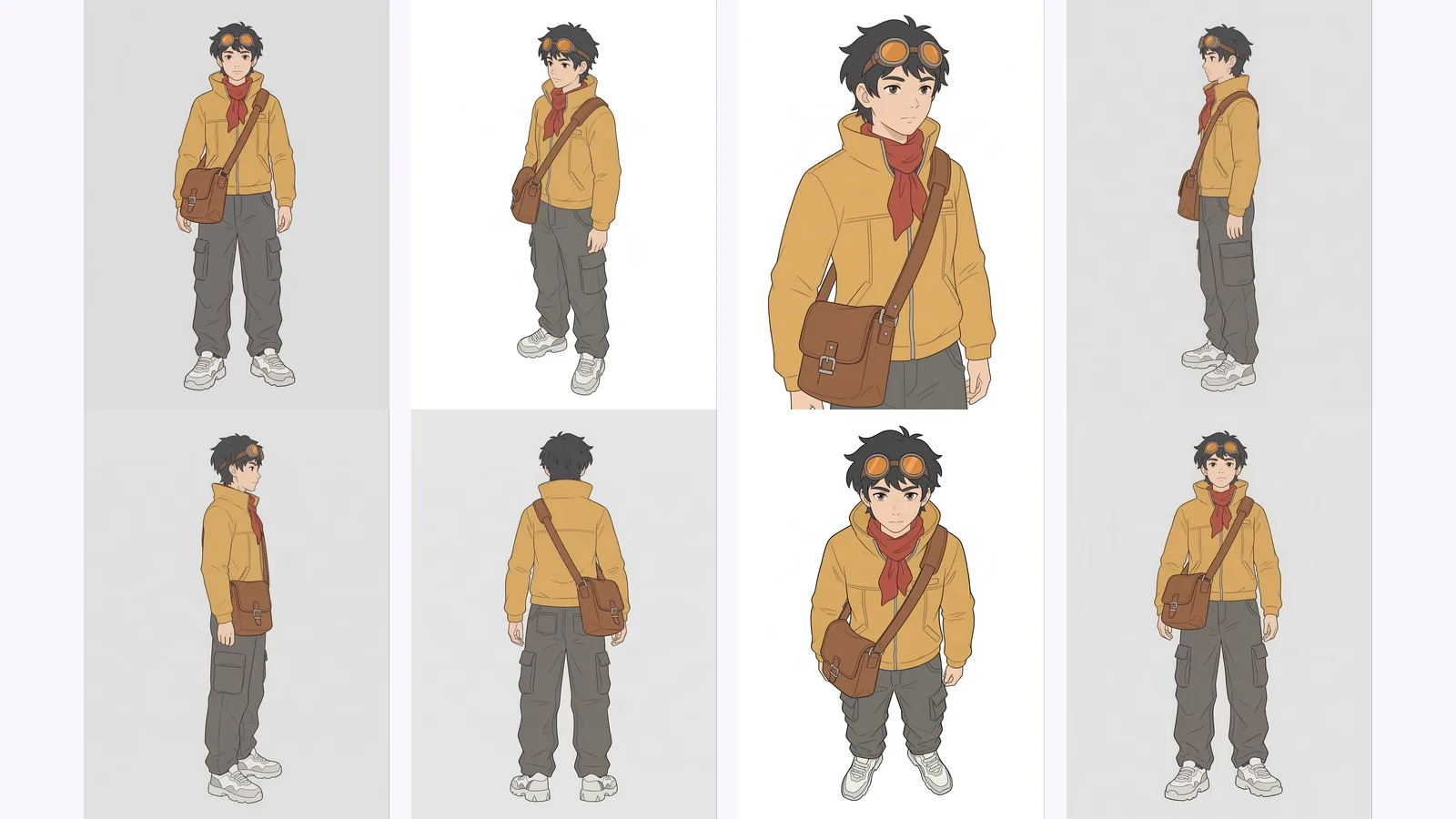
Multi-view images for 3D: the views Meshy, Hunyuan3D-2mv and Tripo take, how to make 8 consistent views from one drawing, and how to check them.
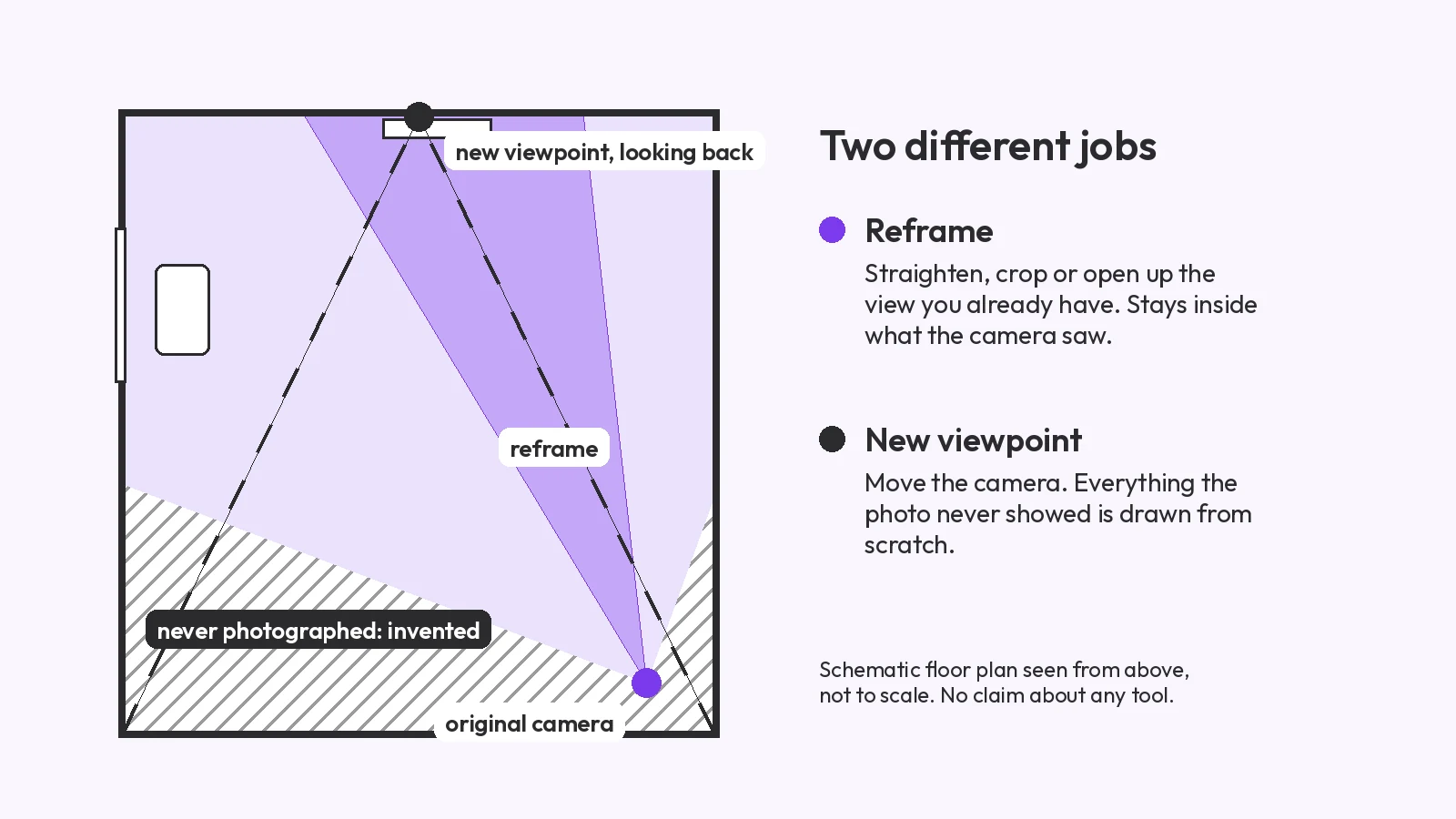
Change the camera angle of a photo with AI: five methods compared, two tested on the same room, and where each one breaks, from reframing to 3D.